Game Concept

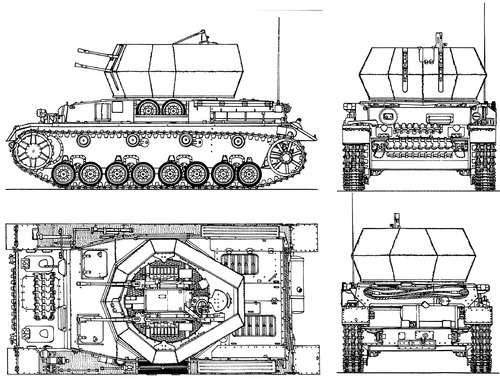
In late 1943, the need for a Flakpanzer was dire. The decision was made by the German Heer (German field army) to reuse chassis of already operational service tanks. The Panzer I and II were outdated or used for other purposes. The Panzer III tank chassis was used for the production of the StuG III and thus not available. The Panzer IV and the Panzer V Panther were considered next. The Panzer IV tank chassis was already in use for several German modifications, so it was decided to use it for the Flakpanzer program. The Panzer V Panther was for a short time considered to be used as a Flakpanzer armed with two 37 mm anti-aircraft guns, but mostly due to high demand for tank hulls, the project never went beyond a wooden mock-up. The first Flakpanzer based on the Panzer IV tank chassis was the 2 cm Flakvierling auf Fahrgestell Panzerkampfwagen IV. Only one prototype was built. It did not receive any production orders but the prototype was modified and upgraded with the larger 3.7 cm Flak 43 (known under the name Möbelwagen by its crews) and around 240 of this version were produced. The Möbelwagen had sufficient firepower to destroy enemy planes and the crew was protected by armored plates on four sides, which needed to be dropped down to use the gun effectively. The Möbelwagen needed time to set up for action and was therefore not a success. In early 1944, Generaloberst Guderian, Generalinspekteur der Panzertruppen (Inspector-General for Armored Troops), gave the In 6 (Inspektion der Panzertruppen 6/ Armored Troops inspection office 6) direct orders to begin work on a new Flakpanzer.